
Wednesday, 29 January 2014
Television on the Borderlands
Dear all, I am very, very happy to announce that my first book has been published :) I had a great stage-fright when it came out in December but now I got used to its presence in bookshops. It is the end of a very long journey. I am particularly enthusiastic about the cover, which looks like this:
.
 .
The funny TV set on the cover is the artwork by Erno Bartha The Triptych from the TV Mania series. I am happy that Erno allowed me to use his work. Firstly because I believe his work, the TV set opening itself is the metaphorical representation of the main argument I make: television by the act of letting in the Other and his own representation (even though within the narrow niche) into the broadcasted main stream communicates interculturally and opens itself and its viewers to the other point of view. Secondly I really enjoyed the TV Mania exhibition that I visited when in Cluj-Napoca, Romania. I found it extremely funny on one hand and theoretically interesting on the other. It is a game with the object that is no longer used and lost its initial function. Now being an empty shell may be filled in with different content, different uses and roles. I have already written about this exhibition earlier on this blog. If you want to see more Bartha’s works visit his site.
.
The book itself is the shortened version of my Ph.D thesis defended in 2010. It is based on analysis and research conducted in 2008 and 2009 so as TV texts are rather ephemeral ones it is in fact it is rather historical book now. I treat it as a representation and critical analysis of a television scape in a given historical moment.
.
The main aim of the book is presenting various strategies the Others are presenting themselves in the main stream of television broadcasting. I was not interested in the images of the otherness created by the representatives of main stream television programmes (as travel series) but the selfportraits the representatives of the nondominant societies and groups are allowed to present – even though these representations can be found mostly in niches. In spite of that one can still perceive cracks on the monolith surface of the mainstream media.
.
The book consists of four chapters. The first one is a methodological one, where multimodal text analysis, content analysis and ethnographical methods are presented and justified. The latter three chapters are case studies of abovementioned cracks in the mainstream media ordered by the geographical scale.
.
The second chapter regards television texts moving in global scale above administrative borders of states and mental borders of nations: the country promotion spots. They are only one way of national branding but, as I see it, the most global and influential as transmitted by the worldwide news channels as CNN or BBC. I analyse them as Arjun Appadurai’s mediascape elements that has the power of setting in motion the human masses (tourists and investors) due to the stir of collective imagination.
.
The third chapter regards the phenomenon that I call the trasnborder television. These are the television programmes that are realized in co-productions by the neighbor states. All analysis in this chapter is based on programmes produced by Polish television in cooperation with German, Ukrainian, Czech, Slovak, Hungarian and Byelorussian broadcasters. Some of them are stable and are still on air, some survived only two or three episodes (Ukrainian ones), some did not survive the political tensions (the case of Byelorussian series).
.
The last chapter is the longest and represents all the methodological equipment I have suggested in the first chapter. It is a monograph of the local scale otherness self-representation in television and regards the national and ethnic minority series in the local subsidiary of Polish Public Television in northern part of Poland Podlasie. It is the most culturally diverse part of the country with Poles, Byelorussians, Ukrainians, Russians, Lithuanians, Roma people and Polish Tatars live together, where three religions – catholic, orthodox and Islam – meet. The research I conducted covers the content analysis, ethnography of the Byelorussian viewers and the journalists creating the minority programmes.
.
Even though I am now so far away from these issues, into totally different groups and media really love this book :)
.
The funny TV set on the cover is the artwork by Erno Bartha The Triptych from the TV Mania series. I am happy that Erno allowed me to use his work. Firstly because I believe his work, the TV set opening itself is the metaphorical representation of the main argument I make: television by the act of letting in the Other and his own representation (even though within the narrow niche) into the broadcasted main stream communicates interculturally and opens itself and its viewers to the other point of view. Secondly I really enjoyed the TV Mania exhibition that I visited when in Cluj-Napoca, Romania. I found it extremely funny on one hand and theoretically interesting on the other. It is a game with the object that is no longer used and lost its initial function. Now being an empty shell may be filled in with different content, different uses and roles. I have already written about this exhibition earlier on this blog. If you want to see more Bartha’s works visit his site.
.
The book itself is the shortened version of my Ph.D thesis defended in 2010. It is based on analysis and research conducted in 2008 and 2009 so as TV texts are rather ephemeral ones it is in fact it is rather historical book now. I treat it as a representation and critical analysis of a television scape in a given historical moment.
.
The main aim of the book is presenting various strategies the Others are presenting themselves in the main stream of television broadcasting. I was not interested in the images of the otherness created by the representatives of main stream television programmes (as travel series) but the selfportraits the representatives of the nondominant societies and groups are allowed to present – even though these representations can be found mostly in niches. In spite of that one can still perceive cracks on the monolith surface of the mainstream media.
.
The book consists of four chapters. The first one is a methodological one, where multimodal text analysis, content analysis and ethnographical methods are presented and justified. The latter three chapters are case studies of abovementioned cracks in the mainstream media ordered by the geographical scale.
.
The second chapter regards television texts moving in global scale above administrative borders of states and mental borders of nations: the country promotion spots. They are only one way of national branding but, as I see it, the most global and influential as transmitted by the worldwide news channels as CNN or BBC. I analyse them as Arjun Appadurai’s mediascape elements that has the power of setting in motion the human masses (tourists and investors) due to the stir of collective imagination.
.
The third chapter regards the phenomenon that I call the trasnborder television. These are the television programmes that are realized in co-productions by the neighbor states. All analysis in this chapter is based on programmes produced by Polish television in cooperation with German, Ukrainian, Czech, Slovak, Hungarian and Byelorussian broadcasters. Some of them are stable and are still on air, some survived only two or three episodes (Ukrainian ones), some did not survive the political tensions (the case of Byelorussian series).
.
The last chapter is the longest and represents all the methodological equipment I have suggested in the first chapter. It is a monograph of the local scale otherness self-representation in television and regards the national and ethnic minority series in the local subsidiary of Polish Public Television in northern part of Poland Podlasie. It is the most culturally diverse part of the country with Poles, Byelorussians, Ukrainians, Russians, Lithuanians, Roma people and Polish Tatars live together, where three religions – catholic, orthodox and Islam – meet. The research I conducted covers the content analysis, ethnography of the Byelorussian viewers and the journalists creating the minority programmes.
.
Even though I am now so far away from these issues, into totally different groups and media really love this book :)

Monday, 21 October 2013
The sky is the limit
I really do not know why this is happening, but whenever on the plane my brain starts to work extra-intensively. I may spend a week on the beach with 7 must-read inspiring books but the best ideas come on my way back home, on the plane. Is it the change on pressure in the cabin? Or the lack of oxygen maybe. I really don't get it but if I had some frequent flyer status and was able to fly more often I would have my book and serveral articles already written.
It truly amazes me because it is definitely not the case of free time - I may have more of it at home and I am not so productive. Maybe it is the case of the views I experince during the flight? Maybe when you see that the sky is the limit, you act accordingly?:)
Wednesday, 28 March 2012
Perfect Sense (SPOILER)
I have just seen a really interesting film by David MacKenzie "Perfect Sense". The Polish translation of the title is just horrible (terrible title translations is our national sport). It is something like "The last love on the world" :/ Apart from gorgeous Eva Green and Ewan MacGregor the plot is very interesting too, especially in the deaf context.
The story is rather pessimistic one. There are several waves of strange disease striking the humanity. Each attack consists of two phases: first comes the overwhelming emotion (the sadness, rage, hunger, aggressiveness or love) which is followed by the lost of one of the senses. First goes the scent, then taste. The third one the humanity looses is the hearing. Can you imagine? The whole human kind being deaf?
The interesting thing about the film is the adoption process. To each loss people can perfectly adopt sooner or later. The lack of scent and taste can be substituted (in restaurant where the main male character works) with the texture of the food, its humidity or temperature. People still go to the restaurants but are looking for some other experiences then they used to.
The loss of hearing is preceded by the attack of aggressiveness. When infected people wake up after it they realise they are deaf. At first they are being isolated by the services (there are leaflets "If you are deaf stay at home"). They are kept away as unlike the loss of scent and taste deafness is serious loss, that causes the global panic. But even after this plague people can have an ordinary life. With time everything comes back to normal somehow. There are banners in public places with sign language. People are signing in restaurants, they use notes, when attending concerts they are touching the instruments and speakers to feel the sounds.
I am really courious how the Deaf community reacts to this film. On one hand it shows the deafness as a great, horrific loss, a tragedy far more serious than the lack of other senses. On the other hand the idea of deaf humanity is extremely interesting. The deaf communities would lost their uniqueness, the base of their identity and also the ground of their exclusion, but at the same time the whole social life would be organized their way.
I have asked the users of the deaf.pl forum for opinions. I am realy curious what they think about this vision.
The story is rather pessimistic one. There are several waves of strange disease striking the humanity. Each attack consists of two phases: first comes the overwhelming emotion (the sadness, rage, hunger, aggressiveness or love) which is followed by the lost of one of the senses. First goes the scent, then taste. The third one the humanity looses is the hearing. Can you imagine? The whole human kind being deaf?
The interesting thing about the film is the adoption process. To each loss people can perfectly adopt sooner or later. The lack of scent and taste can be substituted (in restaurant where the main male character works) with the texture of the food, its humidity or temperature. People still go to the restaurants but are looking for some other experiences then they used to.
The loss of hearing is preceded by the attack of aggressiveness. When infected people wake up after it they realise they are deaf. At first they are being isolated by the services (there are leaflets "If you are deaf stay at home"). They are kept away as unlike the loss of scent and taste deafness is serious loss, that causes the global panic. But even after this plague people can have an ordinary life. With time everything comes back to normal somehow. There are banners in public places with sign language. People are signing in restaurants, they use notes, when attending concerts they are touching the instruments and speakers to feel the sounds.
I am really courious how the Deaf community reacts to this film. On one hand it shows the deafness as a great, horrific loss, a tragedy far more serious than the lack of other senses. On the other hand the idea of deaf humanity is extremely interesting. The deaf communities would lost their uniqueness, the base of their identity and also the ground of their exclusion, but at the same time the whole social life would be organized their way.
I have asked the users of the deaf.pl forum for opinions. I am realy curious what they think about this vision.
Tuesday, 27 March 2012
The d(D)eaf and the Technology
During my stay at York University the emerging idea of my forthcoming project took more concrete shape. Now I can quite confidently state that the main core of my project is the usage of the technology by the deaf communities in Poland.
There are several tricky issues regarding this topic, that I will consider in the following posts. The first one is the group of the deaf itself. It is a very diverse community. The deaf, are not the same as the Deaf, hard of hearing or people that lost their hearing as adults. In fact all these groups are different and separate to the great extend. It seems that the crucial feature here is the disability. While deafness is very often considered as illness, as a kind of lack the group of Deaf, perceiving themselves as language minority, they won't see their bodies as damaged or disabled because of deafness.
It is very hard to find a common ground for researching and analysing the deaf considering this great difference in self-perception and identity creation. It will be - as I suppose - hard to investigate the technology usage within such a heterogeneous group of people. For sure the Internet usage will be the crucial ground for investigation here (including the usage of social media, vlogging, forums) but also the technologies such as hearing aids or implants will be taken into consideration.
So far I have started the participant observation on one of the most dynamic online deaf community, which is the deaf.pl.
There are several tricky issues regarding this topic, that I will consider in the following posts. The first one is the group of the deaf itself. It is a very diverse community. The deaf, are not the same as the Deaf, hard of hearing or people that lost their hearing as adults. In fact all these groups are different and separate to the great extend. It seems that the crucial feature here is the disability. While deafness is very often considered as illness, as a kind of lack the group of Deaf, perceiving themselves as language minority, they won't see their bodies as damaged or disabled because of deafness.
It is very hard to find a common ground for researching and analysing the deaf considering this great difference in self-perception and identity creation. It will be - as I suppose - hard to investigate the technology usage within such a heterogeneous group of people. For sure the Internet usage will be the crucial ground for investigation here (including the usage of social media, vlogging, forums) but also the technologies such as hearing aids or implants will be taken into consideration.
So far I have started the participant observation on one of the most dynamic online deaf community, which is the deaf.pl.
Thursday, 8 December 2011
November in Schulich School of Business
That is the problem I have always had with writing diaries - discipline and regularity. But now, almost half a year after my last post, here I am again. Last week I have received mail from new media researcher from Budapest proving that actually someone is reading this blog :) So after long months of lack of enthusiasm (and activity here) I am starting up again.
For the whole November I have left my homeland Poland and (thanks to grant from my university) went to York University in Toronto, Canada. The main aim of my visit was Schulich School of Business and especially Robert Kozinets, the author of nethnography method and this book.
I have already discussed the netnographic method of the Internet research here expressing some doubts. Now I had great opportunity to discuss my questions with the team of researchers actually coding and developing the method.
Netnography seems to be most suitable tool for researching online forums. Here the possibilities of observation, interaction, analysis of discoursive practices (access to archives!) and simply gaining access to community (for interviewing) are the best. Netnography however seems to lose its impact when it comes to investigating social network sites as Facebook. How to apply the method to this new form of online social activity?
In this case participation (so obvious and easily achieved on forums) is much more complicated. The researcher can follow some fan sites and groups - as easy as clicking Like it button. But how can he or she participate in a social group gathered on Facebook? Great amount of users protect their sites from the stranger's eye. First researcher need to become online friends with members of the community he/she is investigated. This situationa quite dramaticaly changes the classical researcher-researched relation.
In traditional ethnographic filed researcher is present in a given (limited) time frames. The relation with the observed community might have been intense and close but ended some time. What should I do with my researched FB friend after my research project is finished? Should I delete him/her? If I "keep" this relationship it will include the field in my everyday life much more than in case of offline filed research. On the other hand deleting such "friend" when the research is done points out vividly the objective, exploitive aspect of the relation (with getting rid of the informant researcher no longer needs).
In general the idea of becoming friends with respondents, gaining access to all their private comments, posts, photos, lists of their friends and their posts, photos is a little bit redifining relationship between researcher and his/her object in offline inquiry. This change is even more dramatic as far as amount (and quality) of information the investigated community has about the researcher. In the offline field researcher plays his/her social/professional role. Researcher shapes the relation with the community basing on this role. What is new in Facebook field is the threat of the loss of authority of the researcher. Not only he/she has open access to community members' profiles but also vice versa. Respondents can easily find researcher's easy comments, favourite songs and films, photos from crazy parties. I do not state it has bad influence on the researcher-community relation, maybe it can even make the communication smoother and easier but I do see some very basic differences between ethnographic and netnographic procedure and researcher-field relation.
It came as a surprise to me, that (as far as I know) most of the netnographic research actually performed by Kozinets and his team is not as participatory as I have expected from the method. It seemed to me that it is rather content and discoursive analysis followed by the interviews than becoming part of the community, "being one of them". To tell the truth it was where I have seen the biggest charm and value of this method.
The chance to talk to the "nethnographic team" at York University was a great opportunity to express my doubts - as it turned out they have similar. Robert Kozinets is now working on application of the method to the SNS as Facebook. I am really looking foreward his new text. At the York University I had opportunity to present my research project (where netnography is one of the core tools). Within next few days I will present it here as well.
For the whole November I have left my homeland Poland and (thanks to grant from my university) went to York University in Toronto, Canada. The main aim of my visit was Schulich School of Business and especially Robert Kozinets, the author of nethnography method and this book.
I have already discussed the netnographic method of the Internet research here expressing some doubts. Now I had great opportunity to discuss my questions with the team of researchers actually coding and developing the method.
Netnography seems to be most suitable tool for researching online forums. Here the possibilities of observation, interaction, analysis of discoursive practices (access to archives!) and simply gaining access to community (for interviewing) are the best. Netnography however seems to lose its impact when it comes to investigating social network sites as Facebook. How to apply the method to this new form of online social activity?
In this case participation (so obvious and easily achieved on forums) is much more complicated. The researcher can follow some fan sites and groups - as easy as clicking Like it button. But how can he or she participate in a social group gathered on Facebook? Great amount of users protect their sites from the stranger's eye. First researcher need to become online friends with members of the community he/she is investigated. This situationa quite dramaticaly changes the classical researcher-researched relation.
In traditional ethnographic filed researcher is present in a given (limited) time frames. The relation with the observed community might have been intense and close but ended some time. What should I do with my researched FB friend after my research project is finished? Should I delete him/her? If I "keep" this relationship it will include the field in my everyday life much more than in case of offline filed research. On the other hand deleting such "friend" when the research is done points out vividly the objective, exploitive aspect of the relation (with getting rid of the informant researcher no longer needs).
In general the idea of becoming friends with respondents, gaining access to all their private comments, posts, photos, lists of their friends and their posts, photos is a little bit redifining relationship between researcher and his/her object in offline inquiry. This change is even more dramatic as far as amount (and quality) of information the investigated community has about the researcher. In the offline field researcher plays his/her social/professional role. Researcher shapes the relation with the community basing on this role. What is new in Facebook field is the threat of the loss of authority of the researcher. Not only he/she has open access to community members' profiles but also vice versa. Respondents can easily find researcher's easy comments, favourite songs and films, photos from crazy parties. I do not state it has bad influence on the researcher-community relation, maybe it can even make the communication smoother and easier but I do see some very basic differences between ethnographic and netnographic procedure and researcher-field relation.
It came as a surprise to me, that (as far as I know) most of the netnographic research actually performed by Kozinets and his team is not as participatory as I have expected from the method. It seemed to me that it is rather content and discoursive analysis followed by the interviews than becoming part of the community, "being one of them". To tell the truth it was where I have seen the biggest charm and value of this method.
The chance to talk to the "nethnographic team" at York University was a great opportunity to express my doubts - as it turned out they have similar. Robert Kozinets is now working on application of the method to the SNS as Facebook. I am really looking foreward his new text. At the York University I had opportunity to present my research project (where netnography is one of the core tools). Within next few days I will present it here as well.
Wednesday, 22 June 2011
Life in a Day - filmed by you
Last time I posted the lacture of Michael Wesch from Kansas State University regarding the new powerful change in peoples relations and the possibilities in oneself representation that is possible due to YouTube. That brought to my mind film Life in a Day I have watched month ago during the opening of the Cracow Film Festival. It is a project (or experiment as it is called by “authors”) undertaken on YouTube. Users were asked to submit the videos showing how did they spend 24th of July 2010. I was wandering how will I bear 1,5hour of YouTube-alike films although I can “watch” YouTube for hours without such dilemmas. I suppose I doubted in the change of format. How will YouTube films act on a big screen? How will I react to this clash of media civilizations? My viewer’s experience of YouTube films is far from my cinema experience (private vs. public sphere, dark space in case of cinema etc).
Surprisingly watching Life in a Day was not painful or unpleasant at all. In fact I really believe I could watch this global flow of images all night long.
The discourse of the organizers of the project is very “you-centered”. They underline it intensively that the real author of the film is the “you” - which in fact means the whole community of Internet (YouTube) users. The film is your (our?) perspective on reality. Life in a Day has the strong taste of the Dziga Vertov’s Kino-Pravda (Cinéma vérité). Now everybody can be Vertov’s Man with a Movie Camera recording the flow of everyday life in which trivial elements and everyday life routine is not destructive but on contrary intriguing phenomenon.
The montage of users’ films from all over the world gives the impression of participation in the truly global text in which the western oppressive perspective is less visible than on the other audiovisual platforms such as news. It looks like the strategy of “global Hollywood”* does not work in this case. We can see images from non-dominant countries (as I call regions usually labeled as Third World) shot by inhabitants of these regions, although some of them must have been shot by western “cameramen” as they reveal the surprise of the local customs and reality. However in fact the questioning the strategy of global Hollywood is quite naïve here because the creator of the project is still the western big production studio under the name-brand of Ridley Scott. It constantly upkeeps the division into creative, vibrant prestigious western center, and the rest of the world where the brilliant ideas are realized. All 4,500 hours of footage sent from all over the world had been seen, selected and edited in the western cultural paradigm.
Although many doubts occur (including the question of authorship – on the screeing in Cracow the author of Polish fragment of the film was present, although he was the author of 20-seconds image that neither me nor any of my friends have noticed , is it a real authorship?) Life in a Day seems to be a new quality as far as use the power of networked individuals in creating the new cultural text.
* T. Miller, N. Govil, J. McMurria, R. Maxwell, Global Hollywood, British Film Institute, London 2001 the idea of the mechanism of global Hollywood was inspired by F. Fröbel, J. Heinrich, O. Kreye, The New International Division of Labour, Cambridge University
Press, London, New York 1980.
Saturday, 18 June 2011
Digital Ethnography @ Kansas State University
Below please find great presentation of professor Michael Wesch giving the taste of the anthropological approach to new media platforms.
Enjoy:
0:00 Introduction, YouTube's Big Numbers
2:00 Numa Numa and the Celebration of Webcams
5:53 The Machine is Us/ing Us and the New Mediascape
12:16 Introducing our Research Team
12:56 Who is on YouTube?
13:25 What's on Youtube? Charlie Bit My Finger, Soulja Boy, etc.
17:04 5% of vids are personal vlogs addressed to the YouTube community, Why?
17:30 YouTube in context. The loss of community and "networked individualism" (Wellman)
18:41 Cultural Inversion: individualism and community
19:15 Understanding new forms of community through Participant Observation
21:18 YouTube as a medium for community
23:00 Our first vlogs
25:00 The webcam: Everybody is watching where nobody is ("context collapse")
26:05 Re-cognition and new forms of self-awareness (McLuhan)
27:58 The Anonymity of Watching YouTube: Haters and Lovers
29:53 Aesthetic Arrest
30:25 Connection without Constraint
32:35 Free Hugs: A hero for our mediated culture
34:02 YouTube Drama: Striving for popularity
34:55 An early star: emokid21ohio
36:55 YouTube's Anthenticity Crisis: the story of LonelyGirl15
39:50 Reflections on Authenticity
41:54 Gaming the system / Exposing the System
43:37 Seriously Playful Participatory Media Culture (featuring Us by blimvisible: http://www.youtube.com/watch?v=_yxHKgQyGx0
47:32 Networked Production: The Collab. MadV's "The Message" and the message of YouTube
49:29 Poem: The Little Glass Dot, The Eyes of the World
51:15 Conclusion by bnessel1973
52:50 Dedication and Credits (Our Numa Numa dance)
It is really interesting presentation about anthropological approach to new media platforms with special devotion to YouTube not only as a new media tool, but mainly as a new mean of users expression and a new experience of being in touch (with who – that is completely other issue).
YouTube is not only one application – it is an element of the whole bunch of sites connected in an interactive net, in which all elements can and do influence each other. It is a new relation within mediasphere, that in television would be called intertextuality I suppose. Here the convergence (in the sense Henry Jenkins uses it) is more applicable term catching the sense of the media practices users are performing. Peoples’ activity links platform such as dig, del.icio.us, blogs, YouTube, Facebook…
I suppose YouTube is a great victory of everyday lifa and simple pleasures. As Michael Wesch shows in his presentation most of the videos on YouTube are home videos – simple and funny. On the other hand vlogs present the great deal of self- and technology awareness.
I really like author’s perspective - that shows great deal of anthropological (and ethnographical) sensitivity – presenting media not as its contant or even useful tool of human communication but rather as the milieu of human RELATIONS. I do really wonder if the same tale told a friend face-to-face is different when recorded on vlog or described on blog. If it changes once released to (potentially) hundreds of viewers/readers. If it changes when there is noone physically close to me – there is only computer. I believe there is a change in relation not only the mean of communication. That is the question of human experience which is far more than only the story telling.
Enjoy:
0:00 Introduction, YouTube's Big Numbers
2:00 Numa Numa and the Celebration of Webcams
5:53 The Machine is Us/ing Us and the New Mediascape
12:16 Introducing our Research Team
12:56 Who is on YouTube?
13:25 What's on Youtube? Charlie Bit My Finger, Soulja Boy, etc.
17:04 5% of vids are personal vlogs addressed to the YouTube community, Why?
17:30 YouTube in context. The loss of community and "networked individualism" (Wellman)
18:41 Cultural Inversion: individualism and community
19:15 Understanding new forms of community through Participant Observation
21:18 YouTube as a medium for community
23:00 Our first vlogs
25:00 The webcam: Everybody is watching where nobody is ("context collapse")
26:05 Re-cognition and new forms of self-awareness (McLuhan)
27:58 The Anonymity of Watching YouTube: Haters and Lovers
29:53 Aesthetic Arrest
30:25 Connection without Constraint
32:35 Free Hugs: A hero for our mediated culture
34:02 YouTube Drama: Striving for popularity
34:55 An early star: emokid21ohio
36:55 YouTube's Anthenticity Crisis: the story of LonelyGirl15
39:50 Reflections on Authenticity
41:54 Gaming the system / Exposing the System
43:37 Seriously Playful Participatory Media Culture (featuring Us by blimvisible: http://www.youtube.com/watch?v=_yxHKgQyGx0
47:32 Networked Production: The Collab. MadV's "The Message" and the message of YouTube
49:29 Poem: The Little Glass Dot, The Eyes of the World
51:15 Conclusion by bnessel1973
52:50 Dedication and Credits (Our Numa Numa dance)
It is really interesting presentation about anthropological approach to new media platforms with special devotion to YouTube not only as a new media tool, but mainly as a new mean of users expression and a new experience of being in touch (with who – that is completely other issue).
YouTube is not only one application – it is an element of the whole bunch of sites connected in an interactive net, in which all elements can and do influence each other. It is a new relation within mediasphere, that in television would be called intertextuality I suppose. Here the convergence (in the sense Henry Jenkins uses it) is more applicable term catching the sense of the media practices users are performing. Peoples’ activity links platform such as dig, del.icio.us, blogs, YouTube, Facebook…
I suppose YouTube is a great victory of everyday lifa and simple pleasures. As Michael Wesch shows in his presentation most of the videos on YouTube are home videos – simple and funny. On the other hand vlogs present the great deal of self- and technology awareness.
I really like author’s perspective - that shows great deal of anthropological (and ethnographical) sensitivity – presenting media not as its contant or even useful tool of human communication but rather as the milieu of human RELATIONS. I do really wonder if the same tale told a friend face-to-face is different when recorded on vlog or described on blog. If it changes once released to (potentially) hundreds of viewers/readers. If it changes when there is noone physically close to me – there is only computer. I believe there is a change in relation not only the mean of communication. That is the question of human experience which is far more than only the story telling.
Netnography: obstacles
One of the most problematic issues concerning the netnographical method is the problem of participation and the participant observation on one hand and the ethics and the requirement to reveal my identity as a researcher on the other. That is the point where the announced fall of the observer’s paradox seems to be far too premature.
The participant observation, the method that was the main way of getting to know how people live and act in social context when they are not observed, was doomed to failure as long as researcher was visibly present. Netnography seems to reduce this overwhelming presence to minimum and gives access to peoples behaviours and expressions just as they are. And here lies the problem of participating in the researched online group. Once I reveal my academic background and research intentions I ruin the “nature state” of the group. I am a kind of invader who is the Other, who is observing and asking questions. On the other hand I cannot conduct research pretending to be the newbe.
I am afraid I simply do not believe in full participation (which is an integral part of netnographic procedure) once researcher admits his/her identity. At the same time I do feel that the Internet is a great milieu for a truly anthropological action. For action that is far beyond content analysis or even interviews with online group members. That is becoming a part of the group, taking actions they take, knowing the language they use.
These are the questions I am asking myself on the threshold of my research on this and this online community. Bothe of them are Polish communities of the Deaf. I really wonder how to approach these users to be accepted and gain access to the maximum of activities and senses they create there. This research is connected with my participation in conference about excluded actors of social scene. I would like to investigate how the Deaf are using the Internet as a tool of compensating the off-line inequalities.
The participant observation, the method that was the main way of getting to know how people live and act in social context when they are not observed, was doomed to failure as long as researcher was visibly present. Netnography seems to reduce this overwhelming presence to minimum and gives access to peoples behaviours and expressions just as they are. And here lies the problem of participating in the researched online group. Once I reveal my academic background and research intentions I ruin the “nature state” of the group. I am a kind of invader who is the Other, who is observing and asking questions. On the other hand I cannot conduct research pretending to be the newbe.
I am afraid I simply do not believe in full participation (which is an integral part of netnographic procedure) once researcher admits his/her identity. At the same time I do feel that the Internet is a great milieu for a truly anthropological action. For action that is far beyond content analysis or even interviews with online group members. That is becoming a part of the group, taking actions they take, knowing the language they use.
These are the questions I am asking myself on the threshold of my research on this and this online community. Bothe of them are Polish communities of the Deaf. I really wonder how to approach these users to be accepted and gain access to the maximum of activities and senses they create there. This research is connected with my participation in conference about excluded actors of social scene. I would like to investigate how the Deaf are using the Internet as a tool of compensating the off-line inequalities.
Wednesday, 4 May 2011
Virtual Ethnography in FQS
Forum: Qualitative Social Research is an open-acces and free-download online journal connected with Freie Universität Berlin (Open University in Berlin, Germany). FQS is a peer-reviewed multilingual online journal for qualitative research established in 1999. FQSthematic issues are published tri-annually. Each number is divided into FQS Reviews, FQS Debates, FQS Conferences and FQS Interviews.
In 2007 Forum Qualitative Sozialforschung / Forum: Qualitative Social Research devoted one of its volumes to virtual ethnography
In the volume devoted to virtual ethnography you can find (and download) articles:
Virtual Ethnography by Daniel Domínguez Figaredo, Anne Beaulieu, Adolfo Estalella, Edgar Gómez, Bernt Schnettler, Rosie Read
An introduction to the whole thematic volume
On New Means or New Forms of Investigation. A Methodological Proposal for Online Social Investigation through a Virtual Forum by Rubén Arriazu Muñoz (in Spanish)
Abstract: Processes and instruments of communication have constituted an important object for Internet researchers, and have been investigated using qualitative methodologies in social research. The most common strategy has been to adapt orthodox instruments and procedures to the virtual context. In this paper I address the following questions in order to develop a framework for virtual research. Using a virtual forum as starting point, I ask: Is virtual research a new taxonomy or an extension of conventional social research techniques? Is virtual research located at the same level as face-to-face research? Is it a new communicational research form? This paper presents a methodological approach using virtual forums as tools where asynchronous communication flows. I analyze the use of virtual forums in interaction with the social context, and articulate the method that emerges from this fieldwork situation.
Riereta.net: Epistemic and Political Notes From a Techno-Activist Ethnography by Blanca Callén, Marcel Balasch, Paz Guarderas, Pamela Gutierrez, Alejandra León, Marisela Montenegro, Karla Montenegro, Joan Pujol (in Spanish as well)
Abstract: In this article we report on an ethnographic research experience on Riereta, a techno-activist workshop located in Barcelona, where free software and other technologies are developed and put at the disposal of other political projects and activist collectives. Through our research experience, we answer some methodological issues but also raise related epistemic and political questions: What kind of methodical tools must we implement in order to experience the semiotic and material dimension of the subject? How to introduce the technology in our research activity? What kind of methodology can we develop if we want to be consistent with participants' wishes and ways of life? or How to take account of multiple and different voices that compose every ethnographic comprehension and creative practice? All of these questions could be summarized as an quest for turning social research and ethnographic practice into techno-political action. The article is organized in three parts: 1) the relationship between research subjects and objects variously constituted, shifting from a co-research perspective to an epistemologically articulated one; 2) the methodology applied, close to a performative and virtual ethnographic perspective where some technological tools, such as Tiki-Wiki (http://en.wikipedia.org/wiki/TikiWiki), are used; and 3) the products of the research process: collective and situated understandings of technoactivism.
Field Ethics: Towards Situated Ethics for Ethnographic Research on the Internet by Adolfo Estalella, Elisenda Ardèvol (in Spanish)
Abstract: This article reflects openly on the decisions that researchers have to deal with when undertaking qualitative research, especially ethnography, on the Internet. Our argument takes as starting point the ethical guidelines already developed for human subject research, and the way Internet researchers have tried to adapt these guidelines to their field. We argue that many of these ethical recommendations for researching the Internet have been designed according to specific applications (a chat, a mailing list, a blog, etc.), conferring specific properties to technology and making inferences about the kind of interaction that is taking place through such devices (public or private, for instance). We question these approaches and consider that the attribution of properties to technology restricts the scope of the ethical decisions that the researcher can make. We advocate a dialogical and situated ethical practice that takes into account every particular context when making any ethical decision during research. In line with this proposal, we report some ethical dilemmas that we have had to face in our own fieldwork on blogging practices among Spanish bloggers. We also draw on our experience of creating a "field blog" as part of our research. We describe three axes that have helped us to guide our ethical decisions in the field: the scope of individual data collected for participants in the course of research, the explicit and open presence of the researchers, and the search for symmetry and mutuality with our respondents in the field.
Mobile Subjects, Mobile Methods: Doing Virtual Ethnography in a Feminist Online Network by Michaela Fay
Abstract: In this article I give an account of my cyberethnographic study of the International Women's University "Technology and Culture" (ifu) 2000 and the network its participants formed in the ifu's virtual extension, vifu. The article offers a description of the methodological considerations and challenges I was confronted with whilst carrying out this research. In addition, I explore these methodological considerations on a conceptual level. Primarily concerned with questions of home and belonging and the question of how these notions figure in contemporary mobile lives, I explore here how conducting online research became the only possible method to adequately reflect the "mobile" nature not only of the event ifu and its virtual extension vifu, but also the ways in which participants negotiate belonging and mobility in their respective worlds and to the (v)ifu network.
Logging into the Field—Methodological Reflections on Ethnographic Research in a Pluri-Local and Computer-Mediated Field by Heike Mónika Greschke (in German)
Abstract: This article aims to introduce an ethnic group inhabiting a common virtual space in the World Wide Web (WWW), while being physically located in different socio-geographical contexts. Potentially global in its geographical extent, this social formation is constituted by means of interrelating virtual-global dimensions with physically grounded parts of the actors' lifeworlds. In addition, the communities' social life relies on specific communicative practices joining mediated forms of communication with co-presence based encounters. Ethnographic research in a pluri-local and computer-mediated field poses a set of problems which demand thorough reflection as well as a search for creative solutions. How can the boundaries of the field be determined? What does "being there" signify in such a case? Is it possible to enter the field while sitting at my own desk, just by visiting the respective site in the WWW, simply observing the communication going on without even being noticed by the subjects in the field? Or does "being in the field" imply that I ought to turn into a member of the studied community? Am I supposed to effectively live with the others for a while? And then, what can "living together" actually mean in that case? Will I learn enough about the field simply by participating in its virtual activities? Or do I have to account for the physically grounded dimensions of the actors' lifeworlds, as well? Ethnographic research in a pluri-local and computer-mediated field in practice raises a lot of questions regarding the ways of entering the field and being in the field. Some of them will be discussed in this paper by means of reflecting research experiences gained in the context of a recently concluded case study.
Ethnography of Online Role-Playing Games: The Role of Virtual and Real Contest in the Construction of the Field by Simona Isabella
Abstract: This paper invites the reader into the world of MUDs (Multi User Domains). Its underlying goal is to analyse certain social challenges associated with computer mediated communication (CMC), specifically with respect to the concept of the game; the process involved in the construction of the online Self or personality, potentially perceived as the final culmination of the frequent "comings and goings" between the game and reality; the concept of community that develops between two different frames—the virtual world and the real one; and, finally, the concept of both online and offline "experience". The empirical research, focusing on a comparison between an Italian and a Canadian MUDs interactive game, used online ethnography as the basic premise of study and biographical interviews with the players themselves, as further validation of the phenomenon. A fundamental question faces a researcher when conducting the study of a MUD—is the online game the only realm to consider? What is the impact of a multitude of other media (Instant messaging, boards, e-mails, SMS etc.) used by mudders to communicate in order to organize the game and become familiar with each other? Is it necessary for a researcher to totally abandon the players' social premise even if s/he is focusing her/his research on online relationships? These are some of the questions this paper endeavours to answer, while also being cognizant of the methodological problems researchers encounter when studying the Internet, both as a medium (of communication) and as a research framework.
How Did I Get to Princess Margaret? (And How Did I Get Her to the World Wide Web?)
by Kip Jones
Abstract: The paper explores the growing use of tools from the arts and humanities for investigation and dissemination of social science research. Emerging spaces for knowledge transfer, such as the World Wide Web, are explored as outlets for "performative social science". Questions of ethnics and questions of evaluation which emerge from performative social science and the use of new technologies are discussed. Contemporary thinking in aesthetics is explored to answer questions of evaluation. The use of the Internet for productions is proposed as supporting the collective elaboration of meaning supported by Relational Aesthetics. One solution to the ethical problem of performing the narrations of others is the use of the writer's own story as autoethnography. The author queries autoethnography's tendency to tell "sad" stories and proposes an amusing story, exemplified by "The One about Princess Margaret" (see http://www.qualitative-research.net/index.php/fqs/rt/suppFiles/281/618). The conclusion is reached that the free and open environment of the Internet sidelines the usual tediousness of academic publishing and begins to explore new answers to questions posed about the evaluation and ethics of performative social science.
Developing Cyberethnographic Research Methods for Understanding Digitally Mediated Identities by Natalia Rybas, Radhika Gajjala
Abstract: In this essay, we discuss the production of subjectivities at the intersection of local/global and online/offline environments through an engagement with the contexts ethnographically, to illustrate a methodology based on epistemologies of doing. We suggest that researchers studying the production of identity in technospaces must engage in the production of culture and subjectivity in the specific context while interacting with others doing the same in order to gain a nuanced understanding of how identities are formed and performed in such socio-economic environments. Identities thus produced are central to the workings of community situated in specific social, economic and cultural practices and structures of power. Through examining practices that shape these identity formations within various technological environments, we can work towards developing theoretical frameworks that actively shift hierarchies of oppression.
The Internet as a Library-Of-People: For a Cyberethnography of Online Groups by Maurizio Teli, Francesco Pisanu, David Hakken
Abstract: The concept "cyberethnography" remains undefined in the social sciences while, at the same time, still overlapping too much with the more well-known concept of "virtual ethnography." The aim of our paper is to remedy this situation by underlining new directions in the ethnographic study of computer mediated settings. To do so, we define cyberspace as computer-mediated contexts intrinsically related to supposed-to-be "real" places. From this point of view the ethnography of online groups is not just the ethnography of the groups online (or the online ethnography of groups), but it is both the ethnography of online and related off-line situations, the ethnography of humans and non-human actors in these related fields. It is hybrid, like a cyborg. In a word, it is a cyberethnography. In the first part of the paper, we discuss linkages between classical ethnography and its cyber developments. In the second part, we ground epistemologically the argument in favor of a robust social concept of "cyborg" drawing mainly from the fields called Science, Technology and Society (STS), and Organization Studies (OS). In the third part, we focus our argument on web-based group issues, using field data from our own research to define this kind of group and propose a metaphor, "the Internet as a library-of-people." This metaphor, which is strictly grounded in the cyborg concept, highlights the cyborgic characteristic of society that arises in research practice.
In 2007 Forum Qualitative Sozialforschung / Forum: Qualitative Social Research devoted one of its volumes to virtual ethnography
In the volume devoted to virtual ethnography you can find (and download) articles:
Virtual Ethnography by Daniel Domínguez Figaredo, Anne Beaulieu, Adolfo Estalella, Edgar Gómez, Bernt Schnettler, Rosie Read
An introduction to the whole thematic volume
On New Means or New Forms of Investigation. A Methodological Proposal for Online Social Investigation through a Virtual Forum by Rubén Arriazu Muñoz (in Spanish)
Abstract: Processes and instruments of communication have constituted an important object for Internet researchers, and have been investigated using qualitative methodologies in social research. The most common strategy has been to adapt orthodox instruments and procedures to the virtual context. In this paper I address the following questions in order to develop a framework for virtual research. Using a virtual forum as starting point, I ask: Is virtual research a new taxonomy or an extension of conventional social research techniques? Is virtual research located at the same level as face-to-face research? Is it a new communicational research form? This paper presents a methodological approach using virtual forums as tools where asynchronous communication flows. I analyze the use of virtual forums in interaction with the social context, and articulate the method that emerges from this fieldwork situation.
Riereta.net: Epistemic and Political Notes From a Techno-Activist Ethnography by Blanca Callén, Marcel Balasch, Paz Guarderas, Pamela Gutierrez, Alejandra León, Marisela Montenegro, Karla Montenegro, Joan Pujol (in Spanish as well)
Abstract: In this article we report on an ethnographic research experience on Riereta, a techno-activist workshop located in Barcelona, where free software and other technologies are developed and put at the disposal of other political projects and activist collectives. Through our research experience, we answer some methodological issues but also raise related epistemic and political questions: What kind of methodical tools must we implement in order to experience the semiotic and material dimension of the subject? How to introduce the technology in our research activity? What kind of methodology can we develop if we want to be consistent with participants' wishes and ways of life? or How to take account of multiple and different voices that compose every ethnographic comprehension and creative practice? All of these questions could be summarized as an quest for turning social research and ethnographic practice into techno-political action. The article is organized in three parts: 1) the relationship between research subjects and objects variously constituted, shifting from a co-research perspective to an epistemologically articulated one; 2) the methodology applied, close to a performative and virtual ethnographic perspective where some technological tools, such as Tiki-Wiki (http://en.wikipedia.org/wiki/TikiWiki), are used; and 3) the products of the research process: collective and situated understandings of technoactivism.
Field Ethics: Towards Situated Ethics for Ethnographic Research on the Internet by Adolfo Estalella, Elisenda Ardèvol (in Spanish)
Abstract: This article reflects openly on the decisions that researchers have to deal with when undertaking qualitative research, especially ethnography, on the Internet. Our argument takes as starting point the ethical guidelines already developed for human subject research, and the way Internet researchers have tried to adapt these guidelines to their field. We argue that many of these ethical recommendations for researching the Internet have been designed according to specific applications (a chat, a mailing list, a blog, etc.), conferring specific properties to technology and making inferences about the kind of interaction that is taking place through such devices (public or private, for instance). We question these approaches and consider that the attribution of properties to technology restricts the scope of the ethical decisions that the researcher can make. We advocate a dialogical and situated ethical practice that takes into account every particular context when making any ethical decision during research. In line with this proposal, we report some ethical dilemmas that we have had to face in our own fieldwork on blogging practices among Spanish bloggers. We also draw on our experience of creating a "field blog" as part of our research. We describe three axes that have helped us to guide our ethical decisions in the field: the scope of individual data collected for participants in the course of research, the explicit and open presence of the researchers, and the search for symmetry and mutuality with our respondents in the field.
Mobile Subjects, Mobile Methods: Doing Virtual Ethnography in a Feminist Online Network by Michaela Fay
Abstract: In this article I give an account of my cyberethnographic study of the International Women's University "Technology and Culture" (ifu) 2000 and the network its participants formed in the ifu's virtual extension, vifu. The article offers a description of the methodological considerations and challenges I was confronted with whilst carrying out this research. In addition, I explore these methodological considerations on a conceptual level. Primarily concerned with questions of home and belonging and the question of how these notions figure in contemporary mobile lives, I explore here how conducting online research became the only possible method to adequately reflect the "mobile" nature not only of the event ifu and its virtual extension vifu, but also the ways in which participants negotiate belonging and mobility in their respective worlds and to the (v)ifu network.
Logging into the Field—Methodological Reflections on Ethnographic Research in a Pluri-Local and Computer-Mediated Field by Heike Mónika Greschke (in German)
Abstract: This article aims to introduce an ethnic group inhabiting a common virtual space in the World Wide Web (WWW), while being physically located in different socio-geographical contexts. Potentially global in its geographical extent, this social formation is constituted by means of interrelating virtual-global dimensions with physically grounded parts of the actors' lifeworlds. In addition, the communities' social life relies on specific communicative practices joining mediated forms of communication with co-presence based encounters. Ethnographic research in a pluri-local and computer-mediated field poses a set of problems which demand thorough reflection as well as a search for creative solutions. How can the boundaries of the field be determined? What does "being there" signify in such a case? Is it possible to enter the field while sitting at my own desk, just by visiting the respective site in the WWW, simply observing the communication going on without even being noticed by the subjects in the field? Or does "being in the field" imply that I ought to turn into a member of the studied community? Am I supposed to effectively live with the others for a while? And then, what can "living together" actually mean in that case? Will I learn enough about the field simply by participating in its virtual activities? Or do I have to account for the physically grounded dimensions of the actors' lifeworlds, as well? Ethnographic research in a pluri-local and computer-mediated field in practice raises a lot of questions regarding the ways of entering the field and being in the field. Some of them will be discussed in this paper by means of reflecting research experiences gained in the context of a recently concluded case study.
Ethnography of Online Role-Playing Games: The Role of Virtual and Real Contest in the Construction of the Field by Simona Isabella
Abstract: This paper invites the reader into the world of MUDs (Multi User Domains). Its underlying goal is to analyse certain social challenges associated with computer mediated communication (CMC), specifically with respect to the concept of the game; the process involved in the construction of the online Self or personality, potentially perceived as the final culmination of the frequent "comings and goings" between the game and reality; the concept of community that develops between two different frames—the virtual world and the real one; and, finally, the concept of both online and offline "experience". The empirical research, focusing on a comparison between an Italian and a Canadian MUDs interactive game, used online ethnography as the basic premise of study and biographical interviews with the players themselves, as further validation of the phenomenon. A fundamental question faces a researcher when conducting the study of a MUD—is the online game the only realm to consider? What is the impact of a multitude of other media (Instant messaging, boards, e-mails, SMS etc.) used by mudders to communicate in order to organize the game and become familiar with each other? Is it necessary for a researcher to totally abandon the players' social premise even if s/he is focusing her/his research on online relationships? These are some of the questions this paper endeavours to answer, while also being cognizant of the methodological problems researchers encounter when studying the Internet, both as a medium (of communication) and as a research framework.
How Did I Get to Princess Margaret? (And How Did I Get Her to the World Wide Web?)
by Kip Jones
Abstract: The paper explores the growing use of tools from the arts and humanities for investigation and dissemination of social science research. Emerging spaces for knowledge transfer, such as the World Wide Web, are explored as outlets for "performative social science". Questions of ethnics and questions of evaluation which emerge from performative social science and the use of new technologies are discussed. Contemporary thinking in aesthetics is explored to answer questions of evaluation. The use of the Internet for productions is proposed as supporting the collective elaboration of meaning supported by Relational Aesthetics. One solution to the ethical problem of performing the narrations of others is the use of the writer's own story as autoethnography. The author queries autoethnography's tendency to tell "sad" stories and proposes an amusing story, exemplified by "The One about Princess Margaret" (see http://www.qualitative-research.net/index.php/fqs/rt/suppFiles/281/618). The conclusion is reached that the free and open environment of the Internet sidelines the usual tediousness of academic publishing and begins to explore new answers to questions posed about the evaluation and ethics of performative social science.
Developing Cyberethnographic Research Methods for Understanding Digitally Mediated Identities by Natalia Rybas, Radhika Gajjala
Abstract: In this essay, we discuss the production of subjectivities at the intersection of local/global and online/offline environments through an engagement with the contexts ethnographically, to illustrate a methodology based on epistemologies of doing. We suggest that researchers studying the production of identity in technospaces must engage in the production of culture and subjectivity in the specific context while interacting with others doing the same in order to gain a nuanced understanding of how identities are formed and performed in such socio-economic environments. Identities thus produced are central to the workings of community situated in specific social, economic and cultural practices and structures of power. Through examining practices that shape these identity formations within various technological environments, we can work towards developing theoretical frameworks that actively shift hierarchies of oppression.
The Internet as a Library-Of-People: For a Cyberethnography of Online Groups by Maurizio Teli, Francesco Pisanu, David Hakken
Abstract: The concept "cyberethnography" remains undefined in the social sciences while, at the same time, still overlapping too much with the more well-known concept of "virtual ethnography." The aim of our paper is to remedy this situation by underlining new directions in the ethnographic study of computer mediated settings. To do so, we define cyberspace as computer-mediated contexts intrinsically related to supposed-to-be "real" places. From this point of view the ethnography of online groups is not just the ethnography of the groups online (or the online ethnography of groups), but it is both the ethnography of online and related off-line situations, the ethnography of humans and non-human actors in these related fields. It is hybrid, like a cyborg. In a word, it is a cyberethnography. In the first part of the paper, we discuss linkages between classical ethnography and its cyber developments. In the second part, we ground epistemologically the argument in favor of a robust social concept of "cyborg" drawing mainly from the fields called Science, Technology and Society (STS), and Organization Studies (OS). In the third part, we focus our argument on web-based group issues, using field data from our own research to define this kind of group and propose a metaphor, "the Internet as a library-of-people." This metaphor, which is strictly grounded in the cyborg concept, highlights the cyborgic characteristic of society that arises in research practice.
Tuesday, 26 April 2011
National and ethnic minorities in Polish media before 1989
Ethnic and national minorities have been present in polish public media sphere since we can observe such phenomenon. Polish public media sphere dates back 1918 when Poland regained independence after over 100 years annexation and became integral country with one media system. This early media public sphere covered press only and on this field minorities were extremely active. At that time ethnic and national minorities constituted the third part of Polish society and their participation in media fully reflected it. The most active minority group were the Ukrainians who published more than 800 titles which mean they covered 5% of publishing market (publishing 124 newspapers in 1937 only). Other active groups as Germans and Jews among others made Polish public and media sphere diverse and multilingual even if a large number of published by them magazines had temporary, political or religious character.
This situation dramatically changed after the WW2 when many regions inhabited by minority groups became part of Soviet Union and other active groups almost vanished from Polish demographical landscape due to war caused migrations (the Germans) and Holocaust. Those who remained had to deal with new communist reality under which all groups not matching the officially accepted ideal – with minorities among them – were doomed to media nonexistence. Minorities were not mentioned in an official diofficialy or were the subject of negative or missinformational discourse (their quantity was downsized, in some cases their existence was denied). The aim of the ruling party, which was the only one in fact, was to delete these groups from public sphere and due to that delete them from social consciousness. The media treated by the party as a powerful tool of propaganda was rajter normative than descriptive. The model of Polish society was simple: one nation, one ideology, one life style. For minorities the process of re-entering Polish media sphere was long and taken step by step. The access to media was restricted and depended on political situation. It was treated by authorities as a punishment or reward - just as many other goods as private telephone or passport.
After the thaw of 1956 the party allowed minority groups to create their own cultural societies - one for each group. They were the only permitted minorities’ activities and had to cover groups needs in all aspects. In late 1950’s those societies began publishing magazines (also one for each group). Although it was a big breakthrough publishing in native tongues did not mean presenting minorities’ own ideas or lifestyles. Those magazines were censured as well as Polish ones and had to represent the same rule of “national form, but socialistic content”. There were topics and people editors weren’t allowed to mention, there were also issues they had to present. Still there were some minority groups that were not granted the access to media: the Germans, Silesians and Kashubian people – all regarded as German and due to that dangerous element in Polish society - and the Roma people – the group stigmatised in the whole Eastern Europe.
All potentially dangerous, heteronymous content (as historical or social issues) was deleted from the minoritys’ magazines (as well as from minorities’public activities) – due to that the pattern of colourful, happy and folkloristic minority was shaped and is still very strong in both Polish minority and ethnic and national minorities, that rather organise another traditional-song-and-dance festival than ground political organisation.
In the late 1950’s two minorities – the Ukrainians and the Byelorussians – were allowed to create their own programmes on the radio. Those programmes were presented in local subsidiaries of Polish Radio. In Podlasie region the Byelorussians had access to five-minutes programme in national language a week. It may seem nothing, but in late 1950’s those several minutes was regarded as a mile step and concession made by the authorities. Just as on press market the content of those programmes was concentrating on issues as culture and education. No political or social topics were allowed at that time. With years the time amount devoted to Byelorussians programmes was growing constantly and reached thirty minutes a week at late 1980’s.
In case of the Ukrainians government was also quite open letting them ground association and press in Ukrainian language and even letting them teach the mother tongue at schools but such open policy was conducted in central Poland where the Ukrainians and Lemkos were translocated in 1947 from southern part of the country. The official reason for the relocation was to brake the groups of Ukrainians national insurgents for the anti-polish actions taken by the members of those groups. For Polish government radio programmes, Ukrainian language at schools were to prevent Ukrainians and Lemkos from coming back to their homes in the southern part of Poland.
Although the party was ready to accept minorities on the press market and in the radio, television was absolutely beyond minorities’ reach until the communism fell down. Power of television in creating reality was too important for the party to let minorities to it. Television’s message had to be monolith clear without the slightest taste of different ideology, lifestyle, language. It had to give the impression of one nation closed in one country. Television was one of the most important weapons in fight with potential (mostly imaginary) enemies.
Magazines or radio programmes for minority groups were not enough for their needs. They were not the means of their own expression, they could not cover hard, painful or difficult topics. They were by no means an alternative for stereotypes and prejudices spread by official media: minorities’ population was understated creating the image of monoethnicity. Two minority groups had even more difficult media (as well as social) situation. The Germans were the last to reach media representation and weren’t treated as a separate group till 1989. Roms (discriminated in all communist bloc) didn’t have media representation at all.
Few magazines and several minutes in local broadcasting stations were rather proves of government’s concession when minorities tried to fight for their rights, for the real and fair representation.
An interesting casus is the group of Byelorussians, that was active and determined enough to create its own non-official press market – as the only minority group in Poland. According to press historians in years 1981-1980 non-officially about fifty titles were published (regular titles, brochures, cards among them). In those publications mostly archival as well as social articles were published but some of them were the text that had no chances to get through the official censorship. In the late 1980’s the group of Byelorussian students was very active – they have contacted Polish political opposition a well as opposition organisation from Byelorussia. That dynamised the non-official publishing activity of the group.
Also Ukrainians saw the chance in the Polish opposition in the late 1980’s. In 1988 with the members of the other minority groups they have sent an open letter to Lech Wałęsa proposing the change of the minority’s mass media representation that spreads the negative stereotypes or even suggest that there are no minority members in the society. In 1989 an open report published by the Ukrainian association the cooperation with Ukrainian television as well as satellite transmission is suggested. They have pointed out that radio programmes in Ukrainian language are not reachable for many Ukrainians as being broadcastes on local subsidiaries of Polish Radio as well as proposed nationwide programmes to which minority members spread all over the city could listen to. On the petition regarding this ideas two thousand signatures were collected.
The 1989 brought complete change in almost all spheres of public life – it was a significant change for minority groups as well...
To be continued...
This situation dramatically changed after the WW2 when many regions inhabited by minority groups became part of Soviet Union and other active groups almost vanished from Polish demographical landscape due to war caused migrations (the Germans) and Holocaust. Those who remained had to deal with new communist reality under which all groups not matching the officially accepted ideal – with minorities among them – were doomed to media nonexistence. Minorities were not mentioned in an official diofficialy or were the subject of negative or missinformational discourse (their quantity was downsized, in some cases their existence was denied). The aim of the ruling party, which was the only one in fact, was to delete these groups from public sphere and due to that delete them from social consciousness. The media treated by the party as a powerful tool of propaganda was rajter normative than descriptive. The model of Polish society was simple: one nation, one ideology, one life style. For minorities the process of re-entering Polish media sphere was long and taken step by step. The access to media was restricted and depended on political situation. It was treated by authorities as a punishment or reward - just as many other goods as private telephone or passport.
After the thaw of 1956 the party allowed minority groups to create their own cultural societies - one for each group. They were the only permitted minorities’ activities and had to cover groups needs in all aspects. In late 1950’s those societies began publishing magazines (also one for each group). Although it was a big breakthrough publishing in native tongues did not mean presenting minorities’ own ideas or lifestyles. Those magazines were censured as well as Polish ones and had to represent the same rule of “national form, but socialistic content”. There were topics and people editors weren’t allowed to mention, there were also issues they had to present. Still there were some minority groups that were not granted the access to media: the Germans, Silesians and Kashubian people – all regarded as German and due to that dangerous element in Polish society - and the Roma people – the group stigmatised in the whole Eastern Europe.
All potentially dangerous, heteronymous content (as historical or social issues) was deleted from the minoritys’ magazines (as well as from minorities’public activities) – due to that the pattern of colourful, happy and folkloristic minority was shaped and is still very strong in both Polish minority and ethnic and national minorities, that rather organise another traditional-song-and-dance festival than ground political organisation.
In the late 1950’s two minorities – the Ukrainians and the Byelorussians – were allowed to create their own programmes on the radio. Those programmes were presented in local subsidiaries of Polish Radio. In Podlasie region the Byelorussians had access to five-minutes programme in national language a week. It may seem nothing, but in late 1950’s those several minutes was regarded as a mile step and concession made by the authorities. Just as on press market the content of those programmes was concentrating on issues as culture and education. No political or social topics were allowed at that time. With years the time amount devoted to Byelorussians programmes was growing constantly and reached thirty minutes a week at late 1980’s.
In case of the Ukrainians government was also quite open letting them ground association and press in Ukrainian language and even letting them teach the mother tongue at schools but such open policy was conducted in central Poland where the Ukrainians and Lemkos were translocated in 1947 from southern part of the country. The official reason for the relocation was to brake the groups of Ukrainians national insurgents for the anti-polish actions taken by the members of those groups. For Polish government radio programmes, Ukrainian language at schools were to prevent Ukrainians and Lemkos from coming back to their homes in the southern part of Poland.
Although the party was ready to accept minorities on the press market and in the radio, television was absolutely beyond minorities’ reach until the communism fell down. Power of television in creating reality was too important for the party to let minorities to it. Television’s message had to be monolith clear without the slightest taste of different ideology, lifestyle, language. It had to give the impression of one nation closed in one country. Television was one of the most important weapons in fight with potential (mostly imaginary) enemies.
Magazines or radio programmes for minority groups were not enough for their needs. They were not the means of their own expression, they could not cover hard, painful or difficult topics. They were by no means an alternative for stereotypes and prejudices spread by official media: minorities’ population was understated creating the image of monoethnicity. Two minority groups had even more difficult media (as well as social) situation. The Germans were the last to reach media representation and weren’t treated as a separate group till 1989. Roms (discriminated in all communist bloc) didn’t have media representation at all.
Few magazines and several minutes in local broadcasting stations were rather proves of government’s concession when minorities tried to fight for their rights, for the real and fair representation.
An interesting casus is the group of Byelorussians, that was active and determined enough to create its own non-official press market – as the only minority group in Poland. According to press historians in years 1981-1980 non-officially about fifty titles were published (regular titles, brochures, cards among them). In those publications mostly archival as well as social articles were published but some of them were the text that had no chances to get through the official censorship. In the late 1980’s the group of Byelorussian students was very active – they have contacted Polish political opposition a well as opposition organisation from Byelorussia. That dynamised the non-official publishing activity of the group.
Also Ukrainians saw the chance in the Polish opposition in the late 1980’s. In 1988 with the members of the other minority groups they have sent an open letter to Lech Wałęsa proposing the change of the minority’s mass media representation that spreads the negative stereotypes or even suggest that there are no minority members in the society. In 1989 an open report published by the Ukrainian association the cooperation with Ukrainian television as well as satellite transmission is suggested. They have pointed out that radio programmes in Ukrainian language are not reachable for many Ukrainians as being broadcastes on local subsidiaries of Polish Radio as well as proposed nationwide programmes to which minority members spread all over the city could listen to. On the petition regarding this ideas two thousand signatures were collected.
The 1989 brought complete change in almost all spheres of public life – it was a significant change for minority groups as well...
To be continued...
Sunday, 24 April 2011
Netnography. Doing Ethnographic Research Online by Robert V. Kozinets

Netnography. Doing Ethnographic Research Online by Robert V. Kozinets (Sage 2010) was my first choice to dip into the method. And it was not only due to the really great cover (which fully matches my aesthetical needs). Kozinets handbook is a very coherently and clearly written introduction to the whole process of netnographic inquiry from the very begging: selecting the topic and the online community to be investigated, the pre-research reflection on how to enter the community, of how to present yourself, through the problem of keeping field notes during all the research stages and finally how to collect and analyse various kinds of data the netnographical paradigm provides. Last but not least, author covers two procedures of research that are not always taken into consideration in Polish context: how to conduct ethical research (with crucial for netnography: copyrights and data protection) and evaluation (that is generally weak chain of the qualitative, soft disciplines).
Many examples of author’s own work, analyses and mistakes makes an impression of going through the workshop designed by Kozinets for a reader. Exercises to which author strongly encourages and appendix with a ready for use form for conducting online research - it all makes this book very helpful.
The new thing for me, as far as academic discourse is concerned, was using feminine forms when mentioning hypothetical researcher. That is something completely unusual for Polish academic writing. It simply speaks to me.
As an ethnographer I never believed in observant participation – the most “ethnographical” method originally invented and developed by Alfred Radcliffe-Brown and Bronisław Malinowski almost century ago. The observer’s paradox – especially in the small communities – seemed an unavoidable and unacceptable element of inquiry to me. That is why in my research on mediated intercultural communication I have chosen open interviews with communities’ opinion leaders. The intereview-based method has its drawbacks, especially when it concerns media (television) decoding. In this case researcher is not investigating the media decoding itself, but the only data to which he/she has access is the autho-biographical metanarration on how respondent decodes herself media decoding. Not to mention that the process of interview analysis and report writing is another process of decoding (of interview transcription)*. Netnography seems to be the golden solution here. I believe it enables the observant participation much more than traditional ethnography, although (as Kozinets suggests) netnographer should always reveal his/her identity and research intentions to the investigated community.
A bit uneasy part of the research process Kozinsts suggests, is the member check. At first I was distrustful of this procedure. In traditional ethnographic inquiry the researcher is the last agenda to draw conclusions and to make the final interpretations. On the one hand member check is more equal procedure that makes a community member researcher’s partner and in some way co-producer of the final report. Still it is the member who knows his or her community the best. But on the other hand I would be afraid of some form of pressure that community might put on researcher to influence their own representation in the report/book or to somehow use the research for their own purposes**.
I strongly recommend Netnography. Doing Ethnographic Research Online as a basis and introduction to ethnography online, with some historical introduction, a kind of archeology of netnography and a discussion over phenomenons such as the distinction between online communities and communities online or the links and crossroads of ethno- and netnography. It is a very useful training as well as set of problems, issues researcher needs to bear before takien up the study.
Here are my notes - partly in Polish :)

*More on this: Researching Audiences, (2003), red. K. Schroeder, K. Drotner, S. Kline, C. Murray, Arnold Publication, London, p.18.
**No, I am not the conspiracy theory enthusiast, even though I am The X Files fan :)
Netnography
After finishing my PhD thesis the phase of The-Graet-Peace-and-Quiet came. I was just having peaceful life without exams, texts to be written for yesterday, analysis to be finished for today. I had only lectures and classes I to be prepared for tomorrow. I had some back logs. I had to catch up with Dexter, Dr House and finally I refreshed The X Files series (separate post will be devoted to this magnificent series that shaped me and my sister when we were children :). I was learning Czech, visited Malaysia and Singapore - the journey I wanted to undertake for a long, long time.
Just living my life.
But this cheerful time came to an end :) And now I have new plan on my horizon. And its name is netnography :)
For the ethnographer the natural next step is the netnography, the more, as Robert Kozinets states, pure offline ethnography seems impossible today. As online and offilne realities and communities become tighter and tighter bounded and blended the immanent element of “classical” ethnographical inquiry should be the virtual one.
As for an ethnographer researching media nethnography seems the obvious choice of methodology. So far I had been concentrating on television as a mean of intercultural communication. Now I would like to devote to new media and the Internet as a milieu for social movements (with particular emphasis on ethnicity and ethnicity-alike communities).
I am aware of the fact that when planning research on the online communities the administrative, map-grounded boundaries needs to be reconsidered. It may happen that the Polish teenage The X Files fan has more in common with his/her online friend from Hungary or Romania than with the neighbor nextdoor. Nonetheless I would like to limit my study to online communities grounded in four states of Vysehrad Group: Czech Republic, Hungary, Poland and Slovakia. I hope to discover to what extend countries of such a similar historical experience, and such substantially different (as far as mentality, values are concerned) make a social/ ethnical use of new technologies.
Here on AUDIOVISUAL media ethnography culture I would like to devote mainly to my slowly evolving netnographic project. If you have any suggestions or ideas please feel free to contact me :)
Just living my life.
But this cheerful time came to an end :) And now I have new plan on my horizon. And its name is netnography :)
For the ethnographer the natural next step is the netnography, the more, as Robert Kozinets states, pure offline ethnography seems impossible today. As online and offilne realities and communities become tighter and tighter bounded and blended the immanent element of “classical” ethnographical inquiry should be the virtual one.
As for an ethnographer researching media nethnography seems the obvious choice of methodology. So far I had been concentrating on television as a mean of intercultural communication. Now I would like to devote to new media and the Internet as a milieu for social movements (with particular emphasis on ethnicity and ethnicity-alike communities).
I am aware of the fact that when planning research on the online communities the administrative, map-grounded boundaries needs to be reconsidered. It may happen that the Polish teenage The X Files fan has more in common with his/her online friend from Hungary or Romania than with the neighbor nextdoor. Nonetheless I would like to limit my study to online communities grounded in four states of Vysehrad Group: Czech Republic, Hungary, Poland and Slovakia. I hope to discover to what extend countries of such a similar historical experience, and such substantially different (as far as mentality, values are concerned) make a social/ ethnical use of new technologies.
Here on AUDIOVISUAL media ethnography culture I would like to devote mainly to my slowly evolving netnographic project. If you have any suggestions or ideas please feel free to contact me :)
Sunday, 27 June 2010
TV Mania in Romania :)
I have spent last weekend in Transylvanian Cluj-Napoca taking part in conference covering the minority politics in East-European countries. I have presented paper devoted to minorities cultural representation in the media and treating them as partners not an object (of cultural policies, protection...). But the dominant paradigm was how to introduce bilingual names in minority inhabited regions, the violating minorities' rights. Such trivial elements as the presence in public sphere, being subject and author of (not exceptionally) media texts seems not as important as the lingual or law regulations. I am sure that minorities’ active presence in public space can be the first step of getting majority accustomed with minorities activities and rights in everyday life.
Being a big fan of Bram Stocker's novel and a devoted enthusiast of F.F Coppola film I was looking for some Dracula-signs (and souvenirs). Unfortunately there were no interesting artifacts of a vampire's history but I have came across wonderful and witty exhibition in Cluj Art Museum titled TV MANIA. Below please find some of the exhibits:

Some of them were quite pessimistic but still very amusing:


In Polish language there is an expression "mowa trawa" which can be translated as "straw talk" - biting remark on television.

Count Monte Christo it is called.
There were several projects that presented fresh perspective and a kind of phenomenological view on TV set as an element of everyday life:

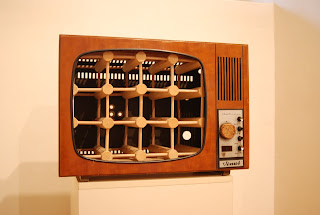


A tricky perspective on television as a mean of communication:

For me the most interesting was the merge between technology and both religion and traditional culture.
TV Triptych:


Embroidery TV

TV set used for creating the traditional painted chest:

It is quite interesting that in traditional groups elements of modern culture are used outside their context as decorative elements (unforgettable glass elements of telegraphic poles as an fancy elements of the gate on polish villages).

And the last one is my favourite Animal TV:

Being a big fan of Bram Stocker's novel and a devoted enthusiast of F.F Coppola film I was looking for some Dracula-signs (and souvenirs). Unfortunately there were no interesting artifacts of a vampire's history but I have came across wonderful and witty exhibition in Cluj Art Museum titled TV MANIA. Below please find some of the exhibits:

Some of them were quite pessimistic but still very amusing:


In Polish language there is an expression "mowa trawa" which can be translated as "straw talk" - biting remark on television.

Count Monte Christo it is called.
There were several projects that presented fresh perspective and a kind of phenomenological view on TV set as an element of everyday life:


A tricky perspective on television as a mean of communication:

For me the most interesting was the merge between technology and both religion and traditional culture.
TV Triptych:


Embroidery TV

TV set used for creating the traditional painted chest:

It is quite interesting that in traditional groups elements of modern culture are used outside their context as decorative elements (unforgettable glass elements of telegraphic poles as an fancy elements of the gate on polish villages).

And the last one is my favourite Animal TV:

Subscribe to:
Posts (Atom)