One of the most problematic issues concerning the netnographical method is the problem of participation and the participant observation on one hand and the ethics and the requirement to reveal my identity as a researcher on the other. That is the point where the announced fall of the observer’s paradox seems to be far too premature.
The participant observation, the method that was the main way of getting to know how people live and act in social context when they are not observed, was doomed to failure as long as researcher was visibly present. Netnography seems to reduce this overwhelming presence to minimum and gives access to peoples behaviours and expressions just as they are. And here lies the problem of participating in the researched online group. Once I reveal my academic background and research intentions I ruin the “nature state” of the group. I am a kind of invader who is the Other, who is observing and asking questions. On the other hand I cannot conduct research pretending to be the newbe.
I am afraid I simply do not believe in full participation (which is an integral part of netnographic procedure) once researcher admits his/her identity. At the same time I do feel that the Internet is a great milieu for a truly anthropological action. For action that is far beyond content analysis or even interviews with online group members. That is becoming a part of the group, taking actions they take, knowing the language they use.
These are the questions I am asking myself on the threshold of my research on this and this online community. Bothe of them are Polish communities of the Deaf. I really wonder how to approach these users to be accepted and gain access to the maximum of activities and senses they create there. This research is connected with my participation in conference about excluded actors of social scene. I would like to investigate how the Deaf are using the Internet as a tool of compensating the off-line inequalities.
Showing posts with label conference. Show all posts
Showing posts with label conference. Show all posts
Saturday, 18 June 2011

Sunday, 27 June 2010
TV Mania in Romania :)
I have spent last weekend in Transylvanian Cluj-Napoca taking part in conference covering the minority politics in East-European countries. I have presented paper devoted to minorities cultural representation in the media and treating them as partners not an object (of cultural policies, protection...). But the dominant paradigm was how to introduce bilingual names in minority inhabited regions, the violating minorities' rights. Such trivial elements as the presence in public sphere, being subject and author of (not exceptionally) media texts seems not as important as the lingual or law regulations. I am sure that minorities’ active presence in public space can be the first step of getting majority accustomed with minorities activities and rights in everyday life.
Being a big fan of Bram Stocker's novel and a devoted enthusiast of F.F Coppola film I was looking for some Dracula-signs (and souvenirs). Unfortunately there were no interesting artifacts of a vampire's history but I have came across wonderful and witty exhibition in Cluj Art Museum titled TV MANIA. Below please find some of the exhibits:

Some of them were quite pessimistic but still very amusing:


In Polish language there is an expression "mowa trawa" which can be translated as "straw talk" - biting remark on television.

Count Monte Christo it is called.
There were several projects that presented fresh perspective and a kind of phenomenological view on TV set as an element of everyday life:

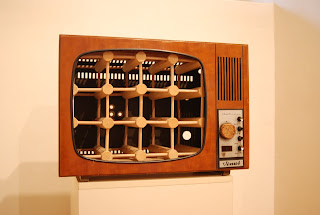


A tricky perspective on television as a mean of communication:

For me the most interesting was the merge between technology and both religion and traditional culture.
TV Triptych:


Embroidery TV

TV set used for creating the traditional painted chest:

It is quite interesting that in traditional groups elements of modern culture are used outside their context as decorative elements (unforgettable glass elements of telegraphic poles as an fancy elements of the gate on polish villages).

And the last one is my favourite Animal TV:

Being a big fan of Bram Stocker's novel and a devoted enthusiast of F.F Coppola film I was looking for some Dracula-signs (and souvenirs). Unfortunately there were no interesting artifacts of a vampire's history but I have came across wonderful and witty exhibition in Cluj Art Museum titled TV MANIA. Below please find some of the exhibits:

Some of them were quite pessimistic but still very amusing:


In Polish language there is an expression "mowa trawa" which can be translated as "straw talk" - biting remark on television.

Count Monte Christo it is called.
There were several projects that presented fresh perspective and a kind of phenomenological view on TV set as an element of everyday life:


A tricky perspective on television as a mean of communication:

For me the most interesting was the merge between technology and both religion and traditional culture.
TV Triptych:


Embroidery TV

TV set used for creating the traditional painted chest:

It is quite interesting that in traditional groups elements of modern culture are used outside their context as decorative elements (unforgettable glass elements of telegraphic poles as an fancy elements of the gate on polish villages).

And the last one is my favourite Animal TV:

Subscribe to:
Posts (Atom)