
Showing posts with label TV. Show all posts
Showing posts with label TV. Show all posts
Wednesday, 29 January 2014
Television on the Borderlands
Dear all, I am very, very happy to announce that my first book has been published :) I had a great stage-fright when it came out in December but now I got used to its presence in bookshops. It is the end of a very long journey. I am particularly enthusiastic about the cover, which looks like this:
.
 .
The funny TV set on the cover is the artwork by Erno Bartha The Triptych from the TV Mania series. I am happy that Erno allowed me to use his work. Firstly because I believe his work, the TV set opening itself is the metaphorical representation of the main argument I make: television by the act of letting in the Other and his own representation (even though within the narrow niche) into the broadcasted main stream communicates interculturally and opens itself and its viewers to the other point of view. Secondly I really enjoyed the TV Mania exhibition that I visited when in Cluj-Napoca, Romania. I found it extremely funny on one hand and theoretically interesting on the other. It is a game with the object that is no longer used and lost its initial function. Now being an empty shell may be filled in with different content, different uses and roles. I have already written about this exhibition earlier on this blog. If you want to see more Bartha’s works visit his site.
.
The book itself is the shortened version of my Ph.D thesis defended in 2010. It is based on analysis and research conducted in 2008 and 2009 so as TV texts are rather ephemeral ones it is in fact it is rather historical book now. I treat it as a representation and critical analysis of a television scape in a given historical moment.
.
The main aim of the book is presenting various strategies the Others are presenting themselves in the main stream of television broadcasting. I was not interested in the images of the otherness created by the representatives of main stream television programmes (as travel series) but the selfportraits the representatives of the nondominant societies and groups are allowed to present – even though these representations can be found mostly in niches. In spite of that one can still perceive cracks on the monolith surface of the mainstream media.
.
The book consists of four chapters. The first one is a methodological one, where multimodal text analysis, content analysis and ethnographical methods are presented and justified. The latter three chapters are case studies of abovementioned cracks in the mainstream media ordered by the geographical scale.
.
The second chapter regards television texts moving in global scale above administrative borders of states and mental borders of nations: the country promotion spots. They are only one way of national branding but, as I see it, the most global and influential as transmitted by the worldwide news channels as CNN or BBC. I analyse them as Arjun Appadurai’s mediascape elements that has the power of setting in motion the human masses (tourists and investors) due to the stir of collective imagination.
.
The third chapter regards the phenomenon that I call the trasnborder television. These are the television programmes that are realized in co-productions by the neighbor states. All analysis in this chapter is based on programmes produced by Polish television in cooperation with German, Ukrainian, Czech, Slovak, Hungarian and Byelorussian broadcasters. Some of them are stable and are still on air, some survived only two or three episodes (Ukrainian ones), some did not survive the political tensions (the case of Byelorussian series).
.
The last chapter is the longest and represents all the methodological equipment I have suggested in the first chapter. It is a monograph of the local scale otherness self-representation in television and regards the national and ethnic minority series in the local subsidiary of Polish Public Television in northern part of Poland Podlasie. It is the most culturally diverse part of the country with Poles, Byelorussians, Ukrainians, Russians, Lithuanians, Roma people and Polish Tatars live together, where three religions – catholic, orthodox and Islam – meet. The research I conducted covers the content analysis, ethnography of the Byelorussian viewers and the journalists creating the minority programmes.
.
Even though I am now so far away from these issues, into totally different groups and media really love this book :)
.
The funny TV set on the cover is the artwork by Erno Bartha The Triptych from the TV Mania series. I am happy that Erno allowed me to use his work. Firstly because I believe his work, the TV set opening itself is the metaphorical representation of the main argument I make: television by the act of letting in the Other and his own representation (even though within the narrow niche) into the broadcasted main stream communicates interculturally and opens itself and its viewers to the other point of view. Secondly I really enjoyed the TV Mania exhibition that I visited when in Cluj-Napoca, Romania. I found it extremely funny on one hand and theoretically interesting on the other. It is a game with the object that is no longer used and lost its initial function. Now being an empty shell may be filled in with different content, different uses and roles. I have already written about this exhibition earlier on this blog. If you want to see more Bartha’s works visit his site.
.
The book itself is the shortened version of my Ph.D thesis defended in 2010. It is based on analysis and research conducted in 2008 and 2009 so as TV texts are rather ephemeral ones it is in fact it is rather historical book now. I treat it as a representation and critical analysis of a television scape in a given historical moment.
.
The main aim of the book is presenting various strategies the Others are presenting themselves in the main stream of television broadcasting. I was not interested in the images of the otherness created by the representatives of main stream television programmes (as travel series) but the selfportraits the representatives of the nondominant societies and groups are allowed to present – even though these representations can be found mostly in niches. In spite of that one can still perceive cracks on the monolith surface of the mainstream media.
.
The book consists of four chapters. The first one is a methodological one, where multimodal text analysis, content analysis and ethnographical methods are presented and justified. The latter three chapters are case studies of abovementioned cracks in the mainstream media ordered by the geographical scale.
.
The second chapter regards television texts moving in global scale above administrative borders of states and mental borders of nations: the country promotion spots. They are only one way of national branding but, as I see it, the most global and influential as transmitted by the worldwide news channels as CNN or BBC. I analyse them as Arjun Appadurai’s mediascape elements that has the power of setting in motion the human masses (tourists and investors) due to the stir of collective imagination.
.
The third chapter regards the phenomenon that I call the trasnborder television. These are the television programmes that are realized in co-productions by the neighbor states. All analysis in this chapter is based on programmes produced by Polish television in cooperation with German, Ukrainian, Czech, Slovak, Hungarian and Byelorussian broadcasters. Some of them are stable and are still on air, some survived only two or three episodes (Ukrainian ones), some did not survive the political tensions (the case of Byelorussian series).
.
The last chapter is the longest and represents all the methodological equipment I have suggested in the first chapter. It is a monograph of the local scale otherness self-representation in television and regards the national and ethnic minority series in the local subsidiary of Polish Public Television in northern part of Poland Podlasie. It is the most culturally diverse part of the country with Poles, Byelorussians, Ukrainians, Russians, Lithuanians, Roma people and Polish Tatars live together, where three religions – catholic, orthodox and Islam – meet. The research I conducted covers the content analysis, ethnography of the Byelorussian viewers and the journalists creating the minority programmes.
.
Even though I am now so far away from these issues, into totally different groups and media really love this book :)

Sunday, 27 June 2010
TV Mania in Romania :)
I have spent last weekend in Transylvanian Cluj-Napoca taking part in conference covering the minority politics in East-European countries. I have presented paper devoted to minorities cultural representation in the media and treating them as partners not an object (of cultural policies, protection...). But the dominant paradigm was how to introduce bilingual names in minority inhabited regions, the violating minorities' rights. Such trivial elements as the presence in public sphere, being subject and author of (not exceptionally) media texts seems not as important as the lingual or law regulations. I am sure that minorities’ active presence in public space can be the first step of getting majority accustomed with minorities activities and rights in everyday life.
Being a big fan of Bram Stocker's novel and a devoted enthusiast of F.F Coppola film I was looking for some Dracula-signs (and souvenirs). Unfortunately there were no interesting artifacts of a vampire's history but I have came across wonderful and witty exhibition in Cluj Art Museum titled TV MANIA. Below please find some of the exhibits:

Some of them were quite pessimistic but still very amusing:


In Polish language there is an expression "mowa trawa" which can be translated as "straw talk" - biting remark on television.

Count Monte Christo it is called.
There were several projects that presented fresh perspective and a kind of phenomenological view on TV set as an element of everyday life:

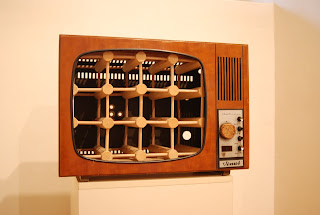


A tricky perspective on television as a mean of communication:

For me the most interesting was the merge between technology and both religion and traditional culture.
TV Triptych:


Embroidery TV

TV set used for creating the traditional painted chest:

It is quite interesting that in traditional groups elements of modern culture are used outside their context as decorative elements (unforgettable glass elements of telegraphic poles as an fancy elements of the gate on polish villages).

And the last one is my favourite Animal TV:

Being a big fan of Bram Stocker's novel and a devoted enthusiast of F.F Coppola film I was looking for some Dracula-signs (and souvenirs). Unfortunately there were no interesting artifacts of a vampire's history but I have came across wonderful and witty exhibition in Cluj Art Museum titled TV MANIA. Below please find some of the exhibits:

Some of them were quite pessimistic but still very amusing:


In Polish language there is an expression "mowa trawa" which can be translated as "straw talk" - biting remark on television.

Count Monte Christo it is called.
There were several projects that presented fresh perspective and a kind of phenomenological view on TV set as an element of everyday life:


A tricky perspective on television as a mean of communication:

For me the most interesting was the merge between technology and both religion and traditional culture.
TV Triptych:


Embroidery TV

TV set used for creating the traditional painted chest:

It is quite interesting that in traditional groups elements of modern culture are used outside their context as decorative elements (unforgettable glass elements of telegraphic poles as an fancy elements of the gate on polish villages).

And the last one is my favourite Animal TV:

Subscribe to:
Posts (Atom)